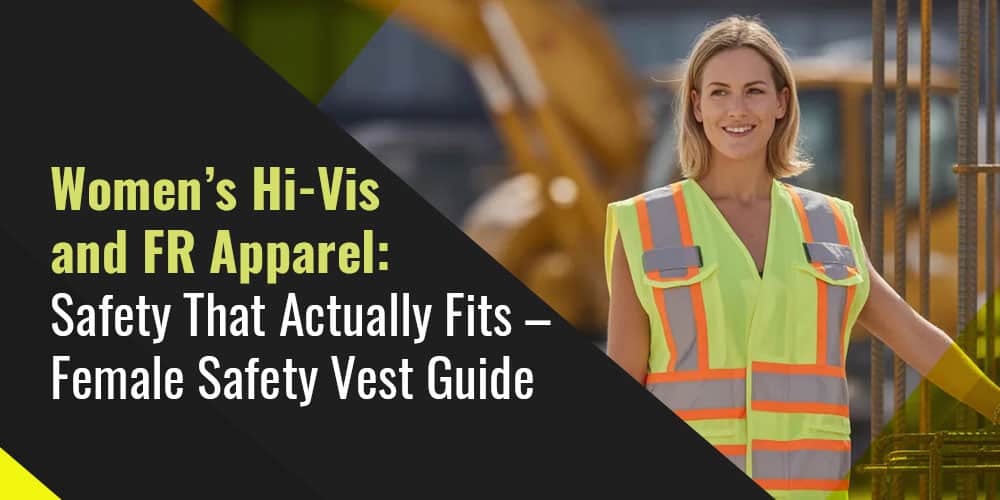
We’re here to solve one problem that shows up on real job sites every day: too many women are still expected to stay visible and protected in PPE that does not fit. Fit is not about looks. Fit is about keeping reflective striping in the right place, reducing snag hazards, moving freely, and staying focused on the task instead of tugging at a vest that rides up.
Women are still a smaller share of the construction workforce, but the number is growing. Recent workforce reporting puts women at about 10.8% of U.S. construction workers. And the PPE fit gap is well documented. In a major survey on women’s PPE, only 29% of respondents said their PPE was designed for women, and 57% said their PPE sometimes or significantly hampers their work.
If you’re buying for yourself, we’ll walk through how to choose the right female safety vest. If you’re buying for a crew, we’ll also cover how to standardize sizing, compliance, and fit testing so people actually wear what you issue.
Key Highlights
- Proper fit reduces snag hazards and prevents fabric from catching on tools, rebar, or machinery.
- Correct sizing keeps reflective tape fully visible, improving driver and equipment operator awareness.
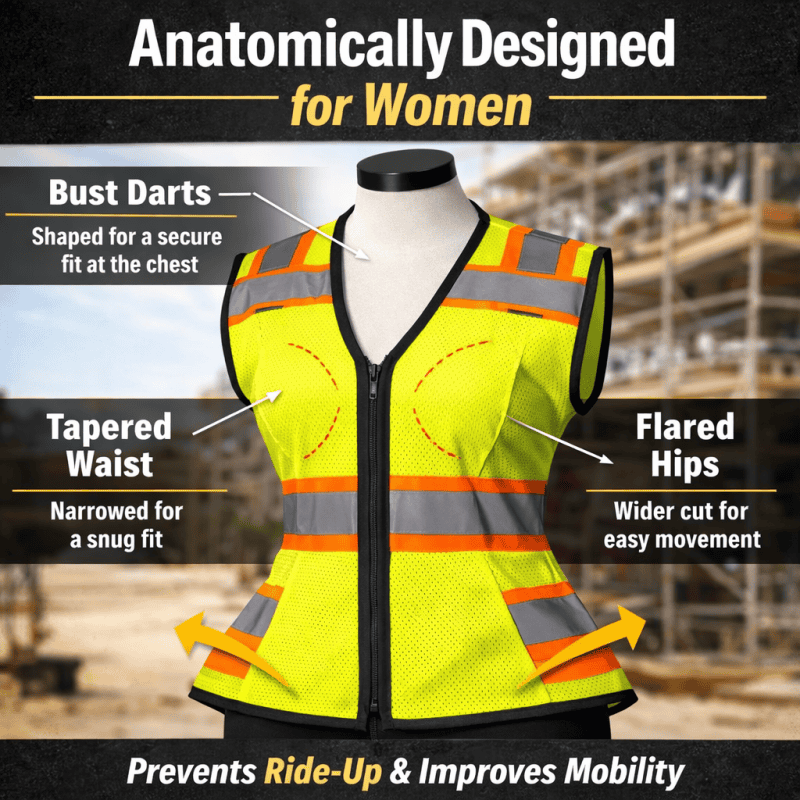
- Women’s vests include tapered waists, hip room, and bust shaping to prevent ride-up and gapping.
- Fit is part of compliance, not a personal preference.
- Women-specific designs improve safety, mobility, and long-term wear compliance.
Why Female-Specific Safety Vests Matter
When a vest fits poorly, the risks are practical and immediate:
- Snag and catch hazards: Loose armholes, excess torso length, and bunching fabric can catch on rebar, ladders, tool belts, and machinery edges.
- Reduced visibility: If the vest rides up, folds, or hangs open, reflective tape can be partially blocked, dirty faster, or sit in the wrong place for drivers and equipment operators to see.
- Lower mobility and slower work: Restriction at the bust or hips can limit reach and twisting. Overly long vests can bump into belts and pockets, especially when climbing or bending.
- Lower compliance: If PPE is uncomfortable, workers adjust it constantly or stop wearing it when supervisors are not nearby.
This is not hypothetical. The “one size does not fit all” issue is repeated across industries, with women reporting day-to-day work impact from ill-fitting PPE.
OSHA’s Personal Protective Equipment standard (29 CFR 1910.132) requires employers to assess workplace hazards, provide appropriate PPE, and ensure it fits properly to protect workers. That means fit is not a comfort preference. It is part of hazard control and regulatory compliance.
Key Features of a Female Safety Vest
A woman’s safety vest is not just a smaller man’s vest. The best designs account for how vests sit on the body while bending, climbing, lifting, and wearing layers.
1. Tapered Waist and Flared Hips
A tapered waist with room at the hips helps prevent two common problems:
- Ride-up when moving: Straight-cut vests can climb up the torso when the hips and thighs move forward, like when stepping up onto equipment.
- Bunching at the beltline: A woman’s cut that follows the waist and hip shape sits flatter, so reflective tape stays more consistently visible.
Look for shaping that keeps the front panels lying flat when you sit, squat, or climb stairs. If the hem flips up easily, the vest is probably too straight through the hips.
2. Bust Accommodations and Torso Length
Women’s vests that actually work on site usually include at least one of these:
- Darts or seams at the bust so the front panel does not pull open.
- Stretch panels that add room without making the whole vest oversized.
- Shorter or proportioned torso length so the vest does not collide with harness belts, tool belts, or hip pockets.
The goal is simple: the vest should close comfortably without tension lines and without leaving the bottom edge so long that it interferes with tools and movement.
3. Adjustability and Closure Types
Closures and adjusters matter more than people expect.
i. Zipper closures
- More secure, less likely to pop open.
- Better at keeping reflective tape aligned.
- Usually preferred for high-activity tasks and windy conditions.
ii. Hook-and-loop (Velcro-style)
- Quick on and off.
- Easier to adjust than changing layers.
- Can collect dust and debris over time, and may lose grip.
iii. Side tabs and elastic panels
- Useful for dialing in fit at the waist and hips.
- Helpful when you rotate between a t-shirt, hoodie, and winter jacket.
If you’re buying for a crew, we usually recommend zip-front options for consistent closure, plus side adjusters to support a wider range of body shapes.
4. Material and Reflectivity Standards
Most female safety vests come in a few common material types:
- Breathable mesh: Best for heat and high exertion. Great airflow, lighter feel.
- Polyester solid fabric: More durable, often better for pockets and abrasion.
- Hybrid mesh and solid: A strong choice when you need both ventilation and pocket structure.
For compliance, high-visibility garments in the U.S. typically align with ANSI/ISEA 107 performance requirements, which cover things like photometric performance, minimum amounts of background and reflective material, and placement rules.
Many employers use ANSI/ISEA as the benchmark for hi-vis selection when workers are exposed to vehicle traffic.
Color note: ANSI/ISEA 107 recognizes specific high-visibility background colors (commonly fluorescent yellow-green and fluorescent orange-red, depending on garment type and class). That’s why “fashion colors” can be a compliance issue.
5. Pockets and Practical Features
Pockets are not a bonus; they change how people work. Useful features include:
- Reinforced lower pockets for tape measures, gloves, or small tools.
- Radio mic tabs and D-rings for accessories (not fall protection).
- Clear ID/badge windows for controlled sites.
- Separate pen slots and notebook pockets for inspectors and supervisors.
If you carry tools daily, choose a vest with reinforced pocket edges and stitching. Thin mesh vests can tear if pockets are overloaded.
Understanding ANSI/ISEA 107 Standards
ANSI/ISEA 107 is the main consensus standard used for high-visibility safety apparel performance in the U.S. It defines requirements for things like visibility materials and their placement to improve worker conspicuity in day and night conditions.
Here’s a practical way to think about the classes:
| ANSI/ISEA 107 Class | Best for | Typical work examples |
| Class 1 | Lowest traffic exposure, more separation from vehicles | Warehouses with limited vehicle interaction, low-speed internal areas |
| Class 2 | Near traffic or moving equipment, higher visual demand | Roadside utility work, construction zones, and manufacturing yards |
| Class 3 | Highest visibility needs, complex backgrounds, higher speeds | Highway work, flagging, night work near traffic, high-risk roadside operations |
Your site policy, DOT requirements, and task risk level usually determine the minimum class. When in doubt, safety managers often choose the higher class for mixed tasks, especially for crews that move between yard work and roadside exposure.
How to Choose the Right Female Safety Vest
Step 1 – Measure for Fit
Measurements take five minutes and prevent weeks of discomfort. Use a flexible tape measure and measure over a thin shirt.
1) Bust
- Measure around the fullest part of the bust.
- Keep the tape level and snug, not tight.
2) Waist
- Measure at the natural waist, usually above the belly button and below the ribs.
3) Torso length
- Measure from the top of the shoulder (near the base of the neck) down to where you want the vest hem to end.
- If you wear a tool belt or harness, measure to a point that will not interfere.
Fit targets we use on-site
- You should be able to zip or close the vest fully without pulling.
- You should be able to reach overhead without the hem lifting into your ribs.
- The vest should sit flat, not tent out at the chest, and not bind at the hips.
If you’re between sizes, decide based on layers. If you work outdoors and wear heavy winter gear, size for the thickest layer you’ll realistically wear.
Step 2 – Determine Your ANSI Class
Match the class to the hazard exposure, not the job title.
- More vehicle exposure, higher speed roads, night work, or complex backgrounds usually mean Class 3.
- General construction zones, utility work, manufacturing yards, or areas with moderate equipment movement often align with Class 2.
- Low-speed, low-exposure areas may allow Class 1, depending on site rules and risk levels.
For procurement teams, we recommend documenting the class decision within your hazard assessment so the requirement stays consistent with your overall safety program and aligns with OSHA’s personal protective equipment standards under 29 CFR 1910 Subpart I.
Step 3 – Consider Environment and Layers
Your environment changes what “fits” means.
i. Hot conditions
- Prioritize mesh or hybrid ventilation.
- Avoid heavy pocket loads that trap heat.
ii. Cold conditions
- Make sure armholes are large enough to layer over insulated jackets.
- Look for adjustable sides so the vest still sits close enough to keep striping visible.
iii. Wet conditions
- Consider hi-vis outerwear instead of a vest over a rain jacket, so the reflective tape is not hidden by water-shedding layers.
If your role crosses seasons, it’s often smarter to have two options: a lightweight mesh vest for summer and a heavier, more structured vest or hi-vis jacket for winter.
Step 4 – Fit Testing and Compliance Checks
Before issuing a new vest program, do a quick field trial.
i. On-person checks
- Walk, squat, climb a ladder, and sit in a vehicle seat.
- Confirm the vest stays closed and does not ride up.
- Check for rubbing at the underarm and neck.
ii. Visibility checks
- Make sure reflective tape is not covered by tool belts, harness straps, radios, or long hair.
- Verify the vest is not so loose that the front hangs open.
iii. Maintenance checks
- Confirm the vest’s reflective elements and background material stay clean and intact. Dirt and wear reduce visibility performance over time.
Top Trends and Innovations in Women’s Hi-Vis Workwear
Women’s PPE is finally moving away from “shrink and pink” and toward functional design. The strongest trends we’re seeing include:
- Stretch fabrics and smarter patterning: Stretch zones that support bending and reaching without turning the vest into a bag.
- Hybrid builds for comfort plus durability: Mesh where you need airflow, solid fabric where you need pockets, and abrasion resistance.
- Integrated FR options for mixed hazards: More women’s hi-vis products are available with flame-resistant performance for environments where flash fire or arc hazards are part of the risk profile. (Always match FR selection to your site’s hazard analysis and required standards.)
- Better sizing systems: Brands are improving women’s size grading so mid sizes are not just scaled-down men’s cuts.
The market is pushing in this direction for a reason. Demand for protective clothing continues to increase globally, with major industry analysis estimating the industrial protective clothing market at approximately USD 18.35 billion in 2022, with strong projected growth. See the full data in this industrial protective clothing market report.
FAQs
1. What is the difference between a man’s and a woman’s safety vest?
Women’s vests are typically designed with a tapered waist, more hip room, and bust shaping, plus proportioned torso length and adjusters that reduce bunching. The practical result is less ride-up, fewer open gaps at the chest, and more consistent reflective tape placement during movement.
2. Why is a properly fitting safety vest so important for women?
Proper fit reduces snag hazards, keeps reflective striping visible, improves mobility, and cuts distractions. Fit also drives compliance; people are far more likely to wear PPE correctly when it feels right, and surveys show ill-fitting PPE can hamper work performance.
3. Are pink safety vests OSHA-compliant?
If a site requires ANSI/ISEA 107 hi-vis compliance, pink is not typically used as an approved primary background color under the standard’s recognized high-visibility colors. Pink may appear as an accent on compliant garments, but for regulated high-vis needs, stick with ANSI-labeled vests in the correct fluorescent background color and class.
4. How do we choose the right size and type of women’s safety vest?
Measure bust, waist, and torso length, then use the manufacturer’s size chart. Size for your normal working layers and choose the ANSI class based on exposure to traffic or equipment. If you’re buying for a team, run a short on-site fit trial and standardize the winning models.
5. Do safety vests have a weight capacity?
Most safety vests are not rated for a specific weight capacity like lifting gear. They are designed for visibility and light carry.
6. How much weight can we safely carry in vest pockets?
There’s no universal number. We suggest keeping pocket loads light enough that the vest does not sag, pull open, or shift reflective tape. For heavier carry, use a tool belt or a dedicated tool vest designed for load distribution, and follow the manufacturer’s guidance.
7. Can we attach a lanyard or fall-arrest device to a safety vest?
A standard hi-vis vest is not fall protection and should not be used as an anchor or harness component. If you need fall protection, use a certified harness system and wear hi-vis in a way that keeps the harness functional and visible.
Fit Drives Visibility. Visibility Drives Safety.
When women’s hi-vis and FR workwear fit correctly, safety performance improves. Reflective striping stays in position. Movement is unrestricted. Workers spend less time adjusting gear and more time focused on the task.
The bottom line is simple: visibility is only effective when the garment fits, closes, and performs the way the standard intended. Choose deliberately. Measure carefully. Standardize intelligently. That is how we improve safety outcomes for every worker on site.