
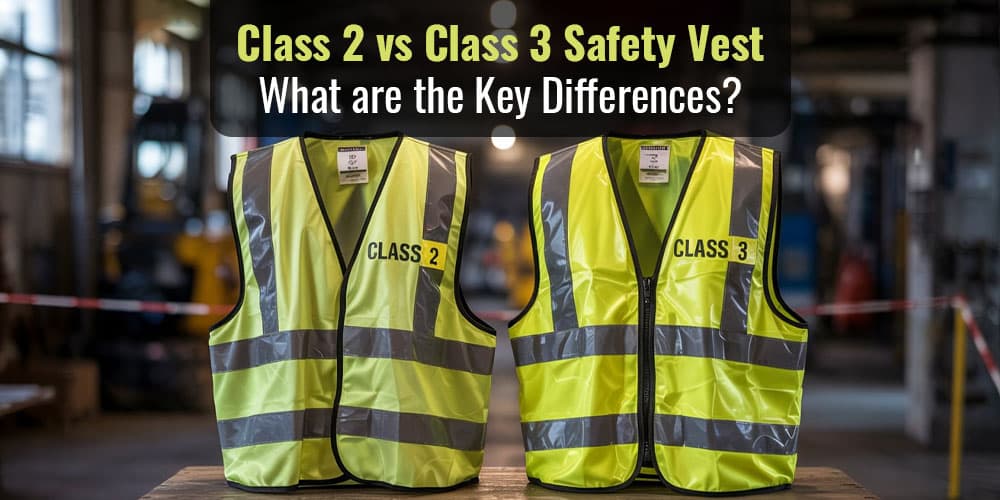
Choosing the wrong safety vest class isn’t just a gear mistake — it’s a compliance failure. Whether you manage a highway construction crew, a utility team, a rail operation, or an emergency response unit, federal regulations tie specific visibility requirements to specific work environments. Put a Class 2 vest on a worker who needs Class 3, and you’ve exposed your crew to elevated struck-by risk and your organization to OSHA scrutiny. This guide cuts through the confusion: here’s exactly how to determine which class your job requires, what the standards actually say, and how to make the right call for every role on your team. For a broader overview, see our ANSI safety vest buying guide.
The Fastest Way to Know Which Class You Need
Most vest class decisions come down to two factors: traffic speed and environmental conditions. Get these two right, and the rest follows naturally.
The One-Rule Traffic Speed Test
If workers are exposed to traffic moving at 25–50 mph, a Class 2 safety vest meets the minimum requirement. If traffic exceeds 50 mph, a Class 3 vest is required — no exceptions. This is the single most reliable rule for initial class selection, and it’s baked into the ANSI/ISEA 107-2020 standard that governs all hi-vis safety apparel in the United States.
When Environmental Conditions Override the Speed Rule
Traffic speed alone doesn’t always determine the right class. Even in a 35 mph zone, Class 3 becomes the appropriate choice when workers face low-light conditions, nighttime shifts, inclement weather, or visually complex backgrounds where a worker can blend into surroundings. If any of these conditions apply, move up to Class 3 regardless of the posted speed limit.
Class 2 vs Class 3 Safety Vest — Side-by-Side Comparison
| Feature | Class 2 | Class 3 |
|---|---|---|
| Background material (min.) | 775 sq. in. | 1,240 sq. in. |
| Retroreflective tape (min.) | 201 sq. in. | 310 sq. in. |
| Reflective tape width (min.) | 1.38 in. | 2 in. |
| Traffic speed threshold | 25–50 mph | 50+ mph |
| Typical environments | Airport, warehouse, daytime utility, survey | Highway, rail, nighttime work, emergency response |
| ANSI/ISEA designation | Type R Class 2 or Type P Class 2 | Type R Class 3 or Type P Class 3 |
| Visual identifier | Sleeveless vest | Sleeved vest or equivalent arm coverage |
| Approximate cost range | $8–$25 | $20–$55 |
Need to order for your crew now? Browse our full selection of Class 2 and Class 3 safety vests to find compliant options across both classes.
What Is a Class 2 Safety Vest?
A Class 2 safety vest is a high-visibility garment designed for work environments where workers face moderate traffic exposure or visual complexity. It provides significantly more background material and retroreflective coverage than a Class 1 vest, making it the standard choice for a wide range of mid-risk job functions.
ANSI Requirements for Class 2 Vests
Under ANSI/ISEA 107-2020, a Class 2 vest must include a minimum of 775 square inches of fluorescent background material — either fluorescent orange-red or fluorescent yellow-green — and at least 201 square inches of retroreflective or combined-performance material. Reflective tape must be at least 1.38 inches wide. These minimums are designed to ensure adequate visibility for drivers approaching at speeds up to 50 mph with enough reaction time to stop or maneuver.
Who Wears a Class 2 Vest? Jobs and Environments
Class 2 vests are appropriate for airport ground crew, daytime road construction workers, utility workers in non-highway settings, survey crews, warehouse staff working near forklifts, toll booth operators, and school crossing guards. The common thread: these workers face real vehicle or equipment exposure, but not at the high speeds or low-visibility conditions that trigger Class 3. For guidance on orange vs yellow safety vests and which color makes sense for each environment, see our dedicated color guide.
What Is a Class 3 Safety Vest?
A Class 3 safety vest is the highest-rated class of hi-vis garment under ANSI/ISEA 107-2020. It’s built for environments where maximum conspicuity is non-negotiable — where vehicle speeds are high, visibility is reduced, or workers must be identifiable at greater distances and across a full range of body motion.
ANSI Requirements for Class 3 Vests
A Class 3 vest must include a minimum of 1,240 square inches of fluorescent background material and at least 310 square inches of retroreflective tape. Reflective tape must be at least 2 inches wide. Critically, Class 3 garments must provide arm coverage — through sleeves or equivalent design — so that a worker’s full body outline is visible to approaching drivers, even during movement. This distinguishes Class 3 visually and functionally from Class 2. Browse our full range of Class 3 safety vests to see compliant options across styles and configurations.
Who Wears a Class 3 Vest? Jobs and Environments
Class 3 vests are required for highway construction crews, flaggers and traffic control personnel, tow truck operators working roadside, railway maintenance workers, emergency responders at highway incidents, and utility workers on night shifts or in adverse weather conditions. These workers operate in environments where the margin for error is minimal — higher speeds, reduced driver reaction time, and complex backgrounds all demand the maximum available visibility.
OSHA and MUTCD — What Compliance Actually Requires
Selecting the wrong vest class isn’t just an internal safety policy issue. Two federal frameworks directly govern hi-vis vest requirements on roadway job sites, and both carry enforcement weight. For a full overview of ANSI standards and how they apply to purchasing decisions, see our ANSI safety vest buying guide.
What the MUTCD Says About Safety Vest Classes
The Manual on Uniform Traffic Control Devices (MUTCD), published by the Federal Highway Administration, requires that all workers in roadway work zones wear high-visibility safety apparel that meets ANSI Class 2 or Class 3 standards — minimum. This requirement applies to any worker within the right-of-way of a public road, regardless of the nature of their task. The MUTCD does not give employers discretion to substitute lower-rated garments based on personal judgment about risk level.
How OSHA Enforces Hi-Vis Vest Requirements
OSHA does not publish a standalone hi-vis vest standard, but it enforces compliance through the General Duty Clause (Section 5(a)(1) of the OSH Act), which requires employers to provide a workplace free from recognized hazards. Struck-by incidents — where a vehicle or equipment strikes a worker — are among the leading causes of fatal occupational injuries in construction and transportation. Because ANSI/ISEA 107-2020 is the established industry standard for controlling this hazard, OSHA treats non-compliance with it as evidence of a General Duty Clause violation. Employers are expected to know the standard and apply it.
What Happens If Workers Wear the Wrong Class?
If an OSHA inspector observes workers in an MUTCD-regulated work zone wearing Class 1 vests — or no compliant vest at all — the agency may cite the employer under the General Duty Clause. Depending on severity and history, citations may carry significant financial penalties. Beyond fines, a struck-by incident involving an under-equipped worker substantially increases employer liability exposure in workers’ compensation and civil proceedings. Using the correct class is both the legal floor and the practical minimum.
Job-by-Job Guide — Which Class Does Each Role Need?
| Job Role | Required Class | Key Environment Condition |
|---|---|---|
| Highway construction crew | Class 3 | Traffic speeds exceeding 50 mph |
| Flagger / traffic control | Class 3 | Direct exposure to moving traffic in work zones |
| Tow truck operator | Class 3 | Roadside work on high-speed roads, often at night |
| Railway / rail maintenance | Class 3 | High-speed rail corridors, complex visual backgrounds |
| Emergency responder (highway) | Class 3 (Type P) | Incident response on active roadways, unpredictable conditions |
| Nighttime utility worker | Class 3 | Low-light conditions override moderate traffic speed |
| Airport ground crew | Class 2 | Vehicle speeds controlled; clear separation from aircraft traffic |
| Surveyor | Class 2 (Class 3 if near highway) | Moderate traffic; upgrade required in high-speed zones |
| Daytime utility worker | Class 2 | Off-highway or controlled-access environments |
| Warehouse / forklift zone | Class 2 | Internal vehicle exposure; no public road access |
| School crossing guard | Class 2 | Low-speed residential or school zone traffic |
| Parking lot / low-speed area | Class 1 or Class 2 | Minimal traffic speed; limited exposure to moving vehicles |
Can You Use a Class 3 Vest Instead of Class 2?
Yes — a Class 3 vest always meets or exceeds Class 2 requirements, so it is fully compliant anywhere a Class 2 vest is mandated. The practical trade-offs are cost and comfort: Class 3 vests cost more and, because of the additional material and sleeves, tend to run warmer in hot conditions. Some safety managers choose to standardize their entire crew on Class 3 regardless of role — it simplifies procurement, eliminates classification errors in the field, and ensures no worker is ever under-equipped if job conditions change mid-shift.
Class 2 vs Class 3 Vest — Cost and Practical Differences
Why Class 3 Vests Cost More
Class 3 vests require roughly 60% more background material and 54% more retroreflective tape than Class 2, plus the design and construction of sleeved coverage. That additional material directly increases manufacturing cost. Specialty configurations — breakaway Class 3 vests for emergency responders, multi-pocket surveyor-style Class 3 vests, or custom logo Class 3 vests — add further to the unit price. Budget planning for Class 3 should account for a per-vest cost roughly 2–3x higher than a standard Class 2 garment.
When the Extra Cost of Class 3 Is Worth It
For any crew regularly working on or near high-speed roadways, the cost difference between Class 2 and Class 3 is marginal compared to the cost of a single OSHA citation, a workers’ compensation claim, or a liability exposure from a struck-by incident. Insurers increasingly factor PPE compliance into premium assessments for construction and transportation fleets. Standardizing on Class 3 across mixed-exposure crews also eliminates the administrative burden of tracking which workers are cleared for which class on which days — a real operational benefit for large or rotating crews.
Type R, Type P, and Type O — What the Letters Actually Mean
When shopping for safety vests, you’ll see designations like “Type R Class 2” or “Type P Class 3” on garment labels. These Type letters indicate the intended work setting, while the Class number indicates the visibility level.
Type O (Occupational) is for off-road use — warehouses, yards, and any site without public vehicular traffic. Type O only supports Class 1.
Type R (Roadway) is for workers exposed to traffic on public roads and highway rights-of-way. Type R supports Class 2 and Class 3, and is the most common designation for construction, utility, and transportation crews.
Type P (Public Safety) is designed for emergency responders, law enforcement, and incident response personnel. Like Type R, it supports Class 2 and Class 3, but the garment design accommodates tactical features such as badge access and breakaway closures.
For a complete technical breakdown of ANSI/ISEA Type and Class designations, see our guide to ANSI Class 2 and Class 3 vest requirements.
How to Choose the Right Safety Vest for Your Crew
Work through these questions before placing your next vest order:
- What is the maximum traffic speed workers will be exposed to? Under 50 mph: Class 2 meets the standard. Over 50 mph: Class 3 is required.
- Will any workers be on night shifts or in low-light conditions? If yes, Class 3 is appropriate regardless of traffic speed.
- Is the work site within a MUTCD-regulated roadway work zone? If yes, Class 2 is the absolute minimum — and Class 3 is the safer default.
- What is the visual background complexity? Construction clutter, dense vegetation, or urban environments may require Class 3 even at lower speeds.
- Do different roles on your crew have different exposure levels? If yes, map each role against the job-by-job table above, or consider standardizing all crew members on Class 3 to simplify compliance management.
- Do you need custom logos, breakaway closures, or specialty configurations? Both Class 2 and Class 3 vests are available with custom logo imprinting and breakaway Class 3 options for public safety roles.
For a deeper look at selecting the right vest configuration for your entire team, see our guide on how to choose a custom safety vest for your crew.
| National Safety Gear offers fast turnaround on custom logo Class 2 and Class 3 vests — browse our Class 3 safety vests or the full selection to find what your crew needs. |
Frequently Asked Questions About Class 2 vs Class 3 Safety Vests
1. What is the difference between a Class 2 and Class 3 safety vest?
A Class 2 safety vest requires a minimum of 775 square inches of background material and 201 square inches of retroreflective tape, and is designed for environments with traffic up to 50 mph. A Class 3 vest requires 1,240 square inches of background material and 310 square inches of reflective tape, adds mandatory arm coverage, and is required for high-speed traffic, night work, and adverse conditions.
2. When is a Class 3 safety vest required?
A Class 3 vest is required when workers are exposed to traffic exceeding 50 mph, working in low-light or nighttime conditions, operating in visually complex environments, or serving in emergency response roles on active roadways. The MUTCD mandates ANSI Class 2 or Class 3 in all roadway work zones, and site-specific risk assessments may require Class 3 even where Class 2 is the technical minimum.
3. Do I need a Class 3 vest for highway work?
Yes. Highway construction and maintenance work — where traffic typically exceeds 50 mph — requires a Class 3 vest under ANSI/ISEA 107-2020 and the MUTCD. Flaggers, ground crew, and any workers within the right-of-way of a high-speed public road must wear Class 3 compliant garments.
4. What does Type R mean on a safety vest?
Type R designates a safety vest intended for roadway environments where workers are exposed to public vehicular traffic. Type R vests are available in Class 2 and Class 3 visibility levels and are the standard designation for construction, utility, and transportation crews working on or near public roads.
5. Can a Class 3 vest be used in place of a Class 2 vest?
Yes. A Class 3 vest meets all Class 2 requirements and is fully compliant wherever Class 2 is mandated. The only trade-offs are higher cost and additional warmth due to the sleeved design. Many employers standardize on Class 3 to simplify compliance across crews with varying exposure levels.
6. What is ANSI/ISEA 107-2020?
ANSI/ISEA 107-2020 is the current American National Standard for high-visibility safety apparel. Published jointly by the American National Standards Institute and the International Safety Equipment Association, it defines the minimum material quantities, reflective performance levels, garment types, and visibility classes required for hi-vis workwear used in the United States.
7. How often should safety vests be replaced?
Safety vests should be replaced when retroreflective tape becomes visibly worn, faded, cracked, or detached, or when background material loses its fluorescent brightness from washing or UV exposure. A vest that no longer meets its original visibility performance — even if it’s still labeled Class 2 or Class 3 — no longer provides compliant protection and should be taken out of service.
National Safety Gear carries a full selection of Class 2 and Class 3 safety vests across styles, colors, and configurations — from standard mesh vests to custom logo options with fast turnaround. Whether you’re outfitting a single worker or an entire crew, we make it straightforward to get ANSI-compliant gear that matches your job site requirements. Need custom branding or breakaway closures? Both are available. Order with confidence knowing every vest ships from a supplier that stocks compliant options across every class and type your team needs.